the piano shed
  • Teaching Blog
  • Sheet Music
  • Private Lessons
  • Video Tutorials
  • About
  • Contact

Jazz, Pop, & Blues Piano Lessons - Available Online and In-Person in the Greater Boston Area

My Favorite Chord on the Piano...Minor 11 voicing breakdown

12/22/2013

1 Comment

 
Picture
I know it's a lot to declare something your absolute "favorite" but I must say if someone asked me right now what my favorite chord voicing on the piano is, I wouldn't hesitate.  It's the minor 11 voicing I'm about to teach you.  Sure, ask me in a couple of years, I'll probably have moved on.  But ever since I heard this voicing I can't get enough!

For those who can't wait to hear and see the specific chord I'm talking about and learn how to play it, check out the video below.   For those who don't want a fish but want to be taught how to fish, let's talk some theory.  

At it's basics a minor 11 chord contains the notes of a minor 7 chord with some tensions added on.  So if we are thinking in terms of a major scale, the 4 notes of a plain old minor 7 chord are the root (1), b3, 5, b7.  For a Cminor7 chord that would be C, Eb, G, Bb.  That covers the plain parts of the chord, but things start to get spicy when we add what are called chord tensions, typically the 9, 11, and 13.  This chord uses the 9th and 11th and leaves out the 13th.  If we are still talking Cminor7 that would be a D and an F.   (Note:  Remember 9th, 11th and 13th are just a fancy way of saying the 2nd, 4th, 6th, but that's for another article)

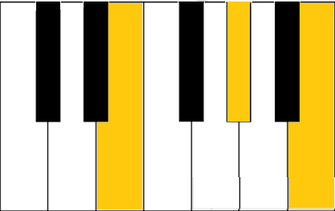
So here are the notes that make up our minor 11 chord:  Root b3, 5, b7, 9, & 11, OR in C -- C, Eb, G, Bb, D, and F.

Notes are one thing, those are just the building blocks of the chord.  Where it really starts to get interesting is the voicings, that is, the arrangement or order in which we play those notes.  

In our left hand we play the Root, 5th, and 9th.  This makes two stacked perfect fifths, a nice open sound.  In the right hand, we play the b3, b7, and the 11.  Guess what?  Two more stacked perfect fifths.  But here's where it gets juicy, when we put our hands together we get an interval between the top note of the left hand and the bottom note of the right hand -- a super crunchy minor 2nd.  So we have a bunch of open sounding fifths and to contrast it we have the bite of the dissonant minor second.  Now that's my kinda voicing.  Check it out, I don't think you'll be disappointed.  

Happy Shedding!  

1 Comment

We all need a little Earth, Wind, & Fire in our lives...

6/20/2013

0 Comments

 
Picture
I recently had to learn the Earth, Wind, & Fire tune "Let's Groove" for a gig and thought I would share it with you all.  

I had a great time just learning the simple bass riff and chord changes and playing along with the recording -- sometimes it just feels so good to get in a rhythm and play along with a killer band.  It's sort of a like a meditation for me.   

Here's the sheet music and recording for you to check out and follow along to.  

Let's Groove - Earth Wind and Fire Piano Arrangement by The Piano Shed - Jazz, Pop, and Blues Music Lessons

Let's Groove by Earth Wind And Fire on Grooveshark
As my students know, one of my favorite things to do is to extract a lesson from a song we are learning -- this I think is how the information really sticks!  One great thing to take away from "Let's Groove" is how to voice minor 7 chords.  Voice, for those that don't know, is just a fancy way of saying what order you play the chord tones in -- you can play a E minor7 chord a lot of different ways -- in different inversions, leaving out or adding certain notes, etc -- each is a different "voicing."  

When you are voicing a minor 7 chord on piano, the simplest thing to do is to play all the chord tones from the root up -- Root, 3rd, 5th, 7th.  If we take the first chord of "Let's Groove," Em7, that would be E, G, B, D.   Go ahead and play that in your right hand, with a bass note (E) in your left. Sure, that sounds ok, but the secret to really sounding pro is just a few steps away.  First off, take out the root from your voicing.  Now try to left hand playing the bass note, E, and your right hand playing just G, B, D.  Much better, right?  If you (or the bass player) is already playing the root, no need to be redundant.  Now change that G, B, D into an inversion -- try D, G, B (still with an E in your left hand).  Now this is a fantastic voicing for an Em7 chord that you hear pianists use all the time.  

Another way to think of this is to play the major triad a minor third up from the root note.  For example, in an Em7 a minor third up from E is a G.  So Em7 becomes G/E.   In an Am7, a minor third up from A is C, so an Am7 becomes a C/A.  

Notice in my arrangement of "Let's Groove" all the different ways of voicing minor 7 chords.  If you like the sound of a certain voicing, try it in all 12 keys!   

Happy Shedding!  
0 Comments

Mulgrew Miller on Comping (Accompanying)

5/30/2013

0 Comments

 
Picture
Yesterday, the jazz world lost a truly great pianist and music educator, Mulgrew Miller.  I was always impressed with the way he could balance the older styles of bebop, swing, and blues with a more modern and modal approach.   "Jazz is part folk art, part progressive art," he once said.  I just love this quote.

If you've never heard of Mulgrew Miller before, I'd recommend reading this article from the New York Times.  While you are at it, check out his solo record from 2010, a true testament to his genius.

Mulgrew Miller spent nearly the last decade of his life mentoring up-and-coming jazz musicians.  We are all fortunate to be left with many of his lessons, many of which were recorded and are available on YouTube for all to benefit from. 

In this clip, Mr. Miller discusses "comping," or accompanying other musicians.  In my opinion, this topic isn't discussed nearly enough when, in fact, it's what pianists spend most of their time doing!

He starts by talking about general comping concepts; don't miss 2:55 when he comps a blues, that's where the REAL LESSON is --  listen to that rhythm! 
Here's a few main points that I would take out of this lesson:

1.  Make the person you are accompanying feel comfortable.
2.  Support, but don't overwhelm, the soloist.
3.  Practice comping by yourself until the rhythm feels good!  It has to dance!

For those of you who really want to get into this, I'd recommend:

1.  Transcribe (and notate) the rhythm of Mr. Miller's comp over the blues
2.  Analyze what you see -- how often does he play upbeats vs. downbeats?  What rhythms does he repeat?  (A common problem I find with a lot of young players comping is that they play too many upbeats without enough downbeats -- remember, the downbeats GROUND the rhythm)
3.  Practice your own voicings using the rhythms that you just transcribed.  Try it a chorus at a time or break it down into smaller two or four bar phrases.  

Thanks to Mulgrew Miller for sharing your time and valuable knowledge to the next generation of jazz players.  You will be missed.


0 Comments
Forward>>

    Recent Posts


    Categories

    All
    Advanced
    Arrangements
    Beginner
    Comping
    Composition
    Harmony
    Imrpovisation
    Inspiration
    Intermediate
    Jazz
    Pop
    R&b
    Rhythm
    Technique
    Transcription
    Two Cents Tuesdays
    Video Tutorials
    Video Tutorials
    Voicings


    Archives

    October 2023
    April 2021
    March 2021
    December 2020
    October 2020
    August 2020
    April 2017
    March 2017
    May 2015
    August 2014
    June 2014
    May 2014
    April 2014
    March 2014
    February 2014
    January 2014
    December 2013
    October 2013
    September 2013
    August 2013
    July 2013
    June 2013
    May 2013
    April 2013
    March 2013
    February 2013


    RSS Feed


The Piano Shed provides fun and creative music instruction specializing in jazz, pop, & blues piano. We serve online students all over the world and local students in the Boston, MA area. Visit our blog for free piano lessons, sheet music and video tutorials! 
Like The Shed on Facebook!  
Subscribe for free lessons on YouTube!
Proudly powered by Weebly